 Rural Home Compass
Scope before spending
What affects the cost of private well water testing?
Start with the question your test needs to answer, not the biggest package or the lowest headline price. A useful estimate describes the work and the result you need.
01 · Quick answer
Define the work before comparing the price.
There is no single testing fee that fits every private well. Your purpose, analytes (the substances being measured), sample collection, laboratory instructions, and local rules define the work. Confirm the complete charge with the laboratory before ordering.
This is a scope-planning guide, not a national price list or a laboratory recommendation.
02 · Cost factors
Why private well testing costs vary
The analytes—not just the count
A panel name is not a complete test specification. Ask which substances and methods it includes, which are excluded, and whether the results answer your actual concern. More tests do not necessarily mean a higher total price; package pricing must be confirmed.
RHC planning adviceGuidelines for Testing Well Water ↗
How the sample will be collected
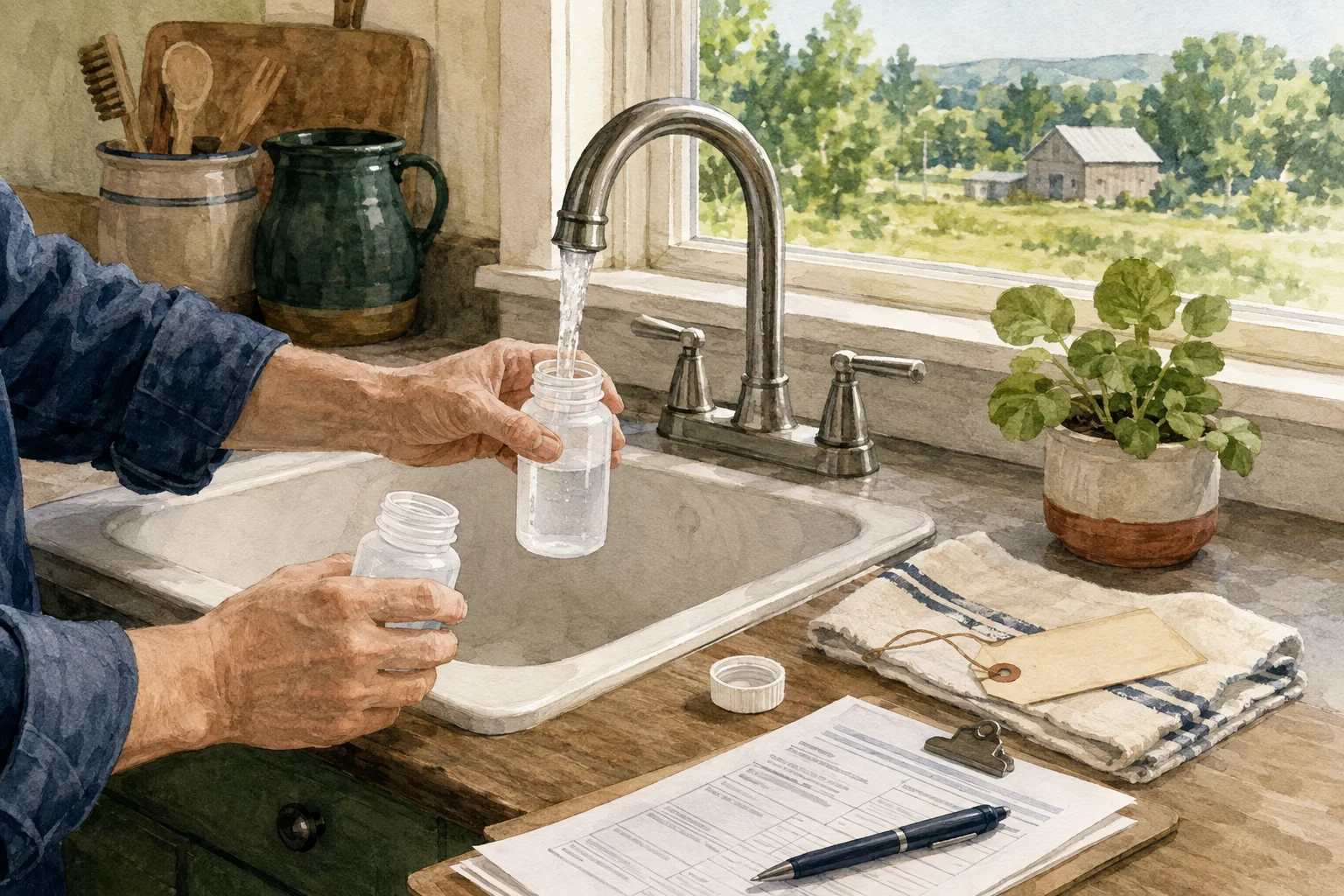
EPA describes laboratory-provided containers and handling instructions; some laboratories offer trained collection. Ask whether self-collection is acceptable for your intended report and whether a collection visit is included.
Official sampling guidance + RHC planning adviceHome Water Testing (2005 sampling guidance) ↗
Delivery, shipping, and handling
Before ordering, ask about containers, preservation, delivery deadlines, return shipping, and any handling charges. Coordinate the collection date with the laboratory rather than assuming any mailed sample will be usable.
RHC planning advice based on sampling guidanceHome Water Testing (2005 sampling guidance) ↗
Who needs to accept the report
For a purchase or approval, confirm the recipient, required report, and collection process before paying. Oregon is a state example: covered domestic-well sales or exchanges have testing and reporting duties, with results supplied to the buyer and OHA. That is not a nationwide reporting rule or surcharge.
Oregon example + RHC planning adviceWell Testing & Regulations ↗
The concern at this particular property
CDC advises identifying potential local contamination before ordering additional chemical tests, which can be expensive. A targeted question for the local health department is more useful than adding every available test by default.
National health guidanceGuidelines for Testing Well Water ↗
03 · Testing scope
Basic testing vs. expanded testing
Basic testing: a routine starting point
Use routine guidance to establish a maintenance baseline, then check the applicable state guidance. “Basic” is a package label, not a universal panel or a guarantee that every possible contaminant has been excluded.
Guidance, not a universal panelGuidelines for Testing Well Water ↗
Expanded testing: a question-specific scope
Additional testing can address a documented local risk, a purchase requirement, a new or repaired well, or a suspected contamination event. Ask what the extra test will help you decide; a broad package does not automatically fit every situation.
Guidance, not a universal panelGuidelines for Testing Well Water ↗Well Testing & Regulations ↗
04 · Your situation
What changes the scope?
These situations may change the work you need—not establish a nationwide fee rule.
Routine homeowner testing
Confirm the routine panel and any local additions before requesting a total. Leave test frequencies and state-specific panels to the relevant testing guidance.
RHC planning adviceGuidelines for Testing Well Water ↗
Buying a home
Check state/local rules and the report recipient’s requirements before choosing a package. In covered Oregon transactions, arsenic, nitrate, and total coliform testing is required through an accredited laboratory. This state example does not establish a national purchase panel. A physical well inspection is a separate service.
Oregon legal example + RHC planning adviceWell Testing & Regulations ↗
New or repaired well
CDC recommends testing after well-system repairs or replacement. Separately, ask the local authority whether construction or approval rules prescribe testing, collection, or reporting. Do not assume a routine homeowner package meets those requirements.
National recommendation + RHC planning adviceGuidelines for Testing Well Water ↗
Known contamination concerns
Flooding, nearby contamination, or a change in taste, odor, or color calls for a focused conversation about testing. Ask the health department which concern to investigate, then ask the laboratory how that changes the scope and collection instructions.
National recommendation + RHC planning adviceGuidelines for Testing Well Water ↗
05 · Before ordering
Avoid paying for the wrong testing.
Use this RHC planning checklist with the laboratory and, where relevant, the authority or person accepting the report.
- Write down the purpose and exact analytes. Compare equivalent scopes, not package names.
- Confirm the laboratory’s certification covers the requested tests; ask the state certification program if the listing is unclear.
- Confirm who may collect the sample, which containers to use, and how and when it must reach the laboratory.
- Confirm that the report will be accepted for its intended use, including any local approval or purchase process.
- Ask for an itemized total: testing, collection, delivery, and reporting where applicable. Prevent avoidable recollection by following instructions; do not skip a recommended confirmation test just to save money.
Official basis for sampling and laboratory selectionGuidelines for Testing Well Water ↗Home Water Testing (2005 sampling guidance) ↗Well Testing & Regulations ↗
06 · Next steps
Use the right page for the next decision.
Official sources
Reviewed 2026-10-02. Oregon is a state example, not a nationwide transaction rule. EPA’s 2005 fact sheet is used for sampling principles, not current prices or fee schedules.
- CDC: Guidelines for Testing Well Water ↗Reviewed 2026-10-02
- EPA: Home Water Testing (2005 sampling guidance) ↗Reviewed 2026-10-02
- Oregon Health Authority: Well Testing & Regulations ↗Reviewed 2026-10-02 · Recheck every 90 days