Rural Home Compass
Water appearance
Cloudy well water: separate air, sediment, and testing questions
Cloudiness is an observation, not a contaminant result. A glass-settling check can help describe whether bubbles or suspended material may be involved, while turbidity and related laboratory tests quantify the change and help decide whether rain, well work, sediment, or microbial concerns need attention.
Start here
The short version
- Note whether a sample clears from the bottom upward, from the top downward, or leaves visible material—but do not treat that observation as proof.
- Test sooner when cloudiness follows flooding, well repair, construction, pressure loss, or a sudden change in color, odor, or taste.
- Turbidity measures clarity; it does not identify the particles or prove the water is microbiologically or chemically safe.
Describe the pattern before ordering tests
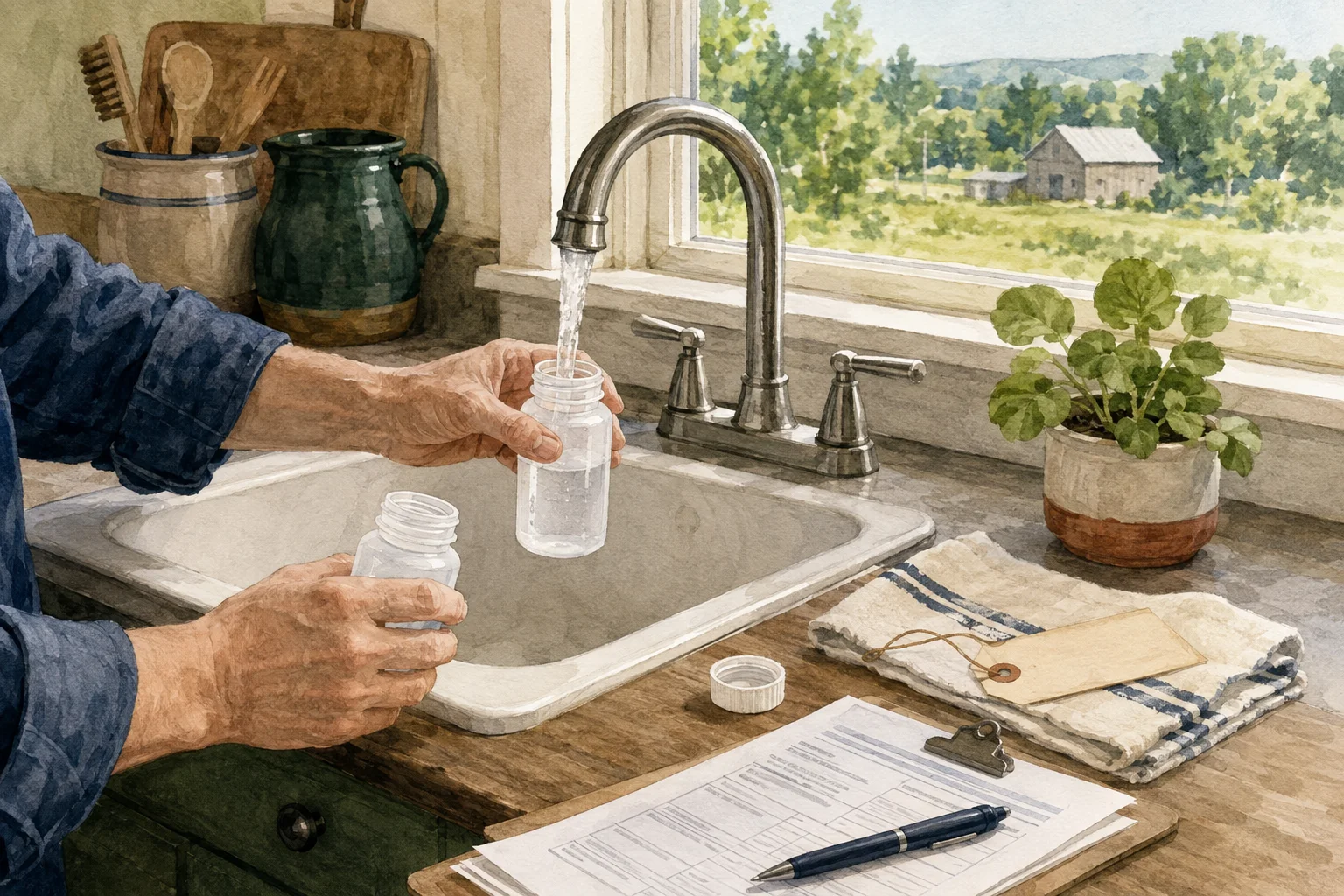
Fill a clear glass and observe it without tasting the water. Fine bubbles may clear differently from suspended particles, while heavier material may settle. Also record whether the problem affects hot and cold water, all fixtures, and whether it changes after the water has run. These observations improve the laboratory conversation but do not establish safety.
Connect the timing to the well system
Cloudiness after flooding, well or pump work, construction, heavy rain, loss of pressure, or a sudden equipment change deserves faster attention. EPA recommends testing when water changes in color, taste, or odor and after conditions near the well change significantly.
Measure the change and test the related risk
Turbidity can quantify suspended material, and University of Georgia guidance pairs cloudy water with turbidity and total suspended solids. A certified laboratory or local health department should determine whether microbial indicators, minerals, or other local analytes should accompany it. Clear-looking water is not a substitute for those results.
Understand the evidence
What these tests can—and cannot—tell you.
Turbidity
Use this record to quantify a cloudiness change and help the laboratory select related microbial, mineral, or sediment checks.
How much the submitted sample scatters light under the laboratory method.
Cannot tell youWhether the cloudiness is air, mineral sediment, clay, microbes, or another material.
Sources and review record
- US EPA: Protect Your Home's WaterReviewed 2026-09-05
- University of Georgia Cooperative Extension: Testing for Water QualityReviewed 2026-09-05
- CDC: Guidelines for Testing Well WaterReviewed 2026-09-05
Keep getting to know your home