 Rural Home Compass
Wisconsin homeowner guide · Private well water
When should you test a private well in Wisconsin?
Wisconsin separates routine owner testing from samples required after regulated well work. Annual bacteria and nitrate testing form the statewide homeowner baseline, arsenic timing changes in three named counties or after a prior detection, and property-transfer inspections, flooding, pregnancy, land use, and pump work create different testing paths.
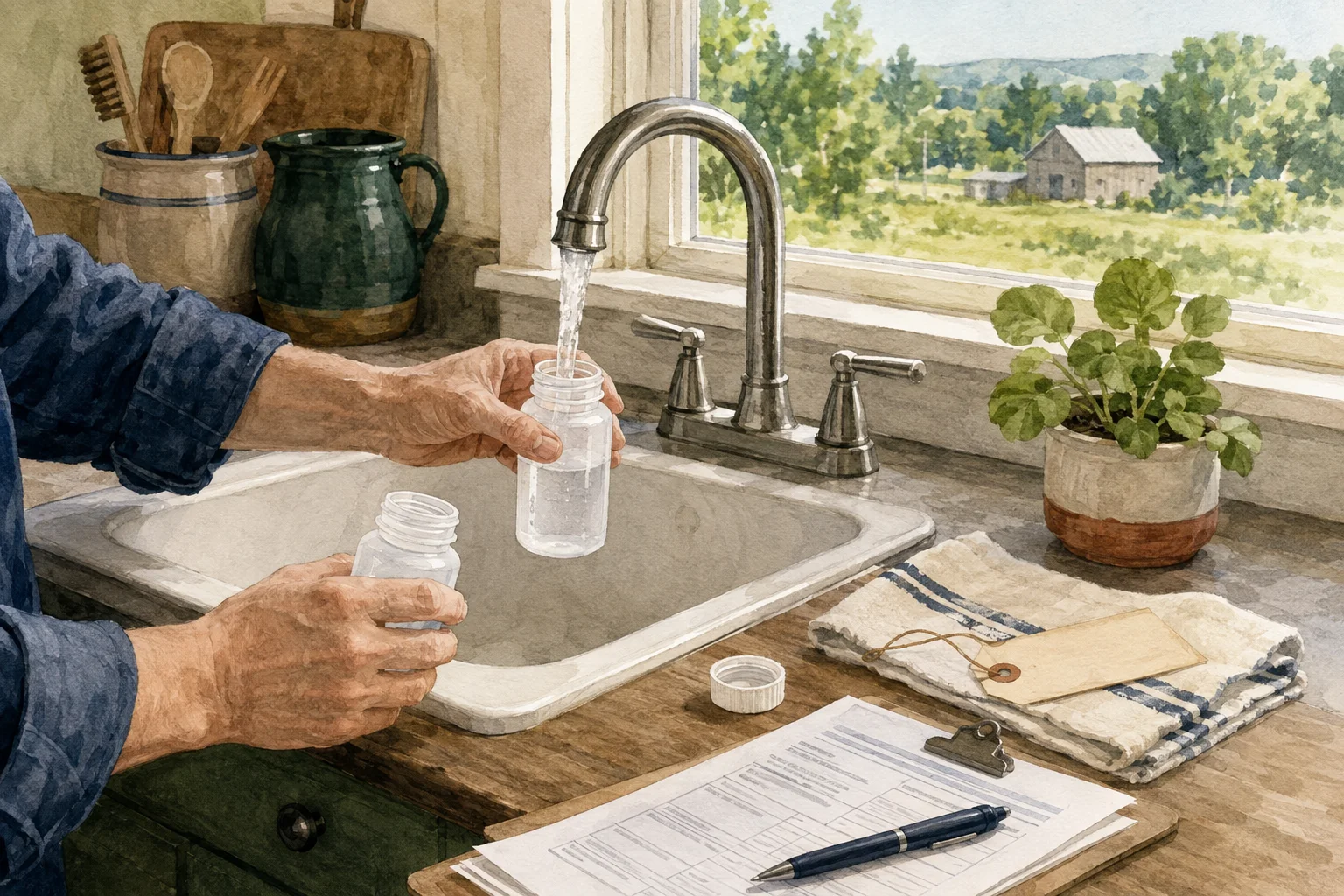
Wisconsin’s useful difference is not a large universal panel: it is a conditional system that combines annual bacteria and nitrate testing, five-year arsenic and lead testing, annual arsenic testing in Brown, Outagamie, and Winnebago counties or after a prior detection, activity-specific professional sampling, and state well-record searches keyed by the Wisconsin Unique Well Number.
Four different decisions
Start with why you are testing.
New well
Use the construction-specific bacteria and nitrate panel.
Wisconsin’s DNR well-contractor guidance identifies total coliform bacteria and nitrate samples after initial well construction, reconstruction, redevelopment, or physical conditioning. The licensed professional submits the regulatory samples to appropriately certified laboratories; other pump-installation activities can trigger a different panel.
- Keep the Well Construction Report, Wisconsin Unique Well Number, first water-quality test form, and laboratory results together.
- Confirm that the responsible driller, constructor, or pump installer has completed the required sampling and electronic reporting for the work performed.
Official guidanceWater sampling and reporting for well and pump work
Buying a home
Separate an optional transfer inspection from ordinary owner sampling.
Wisconsin does not require a well inspection or water testing solely because property is transferred. If a property-transfer well inspection is ordered, it must be performed by a licensed well driller or pump installer, and that inspector must collect samples from each drinking-water well for coliform bacteria including E. coli, nitrate, and arsenic through a certified laboratory.
- Search the DNR construction report and sample-history systems, then compare the records with every active or unused well found on the property.
- Confirm lender or contract requirements and, if ordering a regulated inspection, hire a properly licensed well driller or pump installer rather than treating a general home inspection as equivalent.
Official guidanceProperty transfer well inspectionsGroundwater Retrieval NetworkLook up groundwater and well data
Routine care
Track annual tests and the separate five-year group.
Wisconsin recommends bacteria and nitrate testing at least once a year. Most owners should test arsenic and lead at least every five years, while owners in Brown, Outagamie, or Winnebago counties and owners with a previous arsenic result should test arsenic every year.
- Record bacteria and nitrate every year instead of relying on appearance, taste, or a prior passing result.
- Track arsenic and lead separately, and apply the annual arsenic cadence when the property or prior result meets the state guidance.
Official guidanceTest Your Private Well Water AnnuallyTests for Private Well Users (PUB-DG-023-2026)
Flood or repair
Use safe water and reset the bacteria decision after flooding.
Wisconsin DHS says a well should be treated as flooded when the wellhead or casing was inundated, water changed in taste or color or contains sediment, or a shallow-cased well is near flooded areas. Use unaffected water, have a licensed professional disinfect the well, and test for coliform and E. coli bacteria before returning to normal use; a bacteria-positive result requires continued safe water and confirmation testing.
- Use an unaffected source for drinking, food preparation, and personal hygiene until the post-flood process shows bacteria are absent.
- Ask the local health department about flood test kits and contact a licensed well driller or pump installer if bacteria persist or repair is needed.
Official guidanceFlooding: Private Wells
New wells and regulated work
The required starting tests depend on the work.
Wisconsin identifies a specific starting panel for newly constructed private drinking-water wells. This list belongs to the construction process and is not the routine homeowner schedule.
- Total coliform bacteria
- Nitrate
The responsible professional and certified laboratory determine the accepted sample and report. Do not assume a retail package satisfies a regulatory purpose.
Official basis for the new-well panelWater sampling and reporting for well and pump work
Existing wells
Wisconsin has a state-specific recurring schedule.
Bacteria and nitrate are the recurring statewide baseline; water that looks normal is not evidence that these results remain unchanged.
Official guidanceTest Your Private Well Water AnnuallyTests for Private Well Users (PUB-DG-023-2026)
This is the general cadence. Lead should also be tested before a pregnant person uses the water or it is given to a baby.
Official guidanceTests for Private Well Users (PUB-DG-023-2026)
Use annual arsenic testing in Brown, Outagamie, or Winnebago counties, or after arsenic was found in a previous sample.
Official guidanceTest Your Private Well Water AnnuallyTests for Private Well Users (PUB-DG-023-2026)
The calendar is not the whole answer
When should the panel change?
Pregnancy, possible pregnancy, or a baby in the home
Test nitrate before the water is used by someone who is or may become pregnant or given to a baby; include lead before a pregnant person uses the water or it is given to a baby.
Official guidanceTest Your Private Well Water AnnuallyTests for Private Well Users (PUB-DG-023-2026)
A change in taste, color, or smell
Test for bacteria right away rather than waiting for the next annual date, then use the symptom and local context to decide whether other analytes are credible.
Official guidanceTest Your Private Well Water AnnuallyTests for Private Well Users (PUB-DG-023-2026)
Pump work, well entry, or chemical conditioning
The required professional panel depends on the activity: Wisconsin contractor guidance distinguishes coliform-only work from coliform-plus-nitrate work and from coliform, nitrate, and arsenic testing.
Official guidanceWater sampling and reporting for well and pump work
A flooded well or flood-related water change
Use unaffected water, arrange disinfection by a licensed well professional, test for coliform and E. coli, and obtain confirmation testing when bacteria are found.
Official guidanceFlooding: Private Wells
Local geology, land use, plumbing, or a nearby contamination source
Use local evidence to select additional tests such as fluoride, manganese, strontium, atrazine, PFAS, or VOCs; these are conditional tests, not a universal package for every Wisconsin well.
Official guidanceTest Your Private Well Water AnnuallyTests for Private Well Users (PUB-DG-023-2026)
Laboratory and sampling
Confirm the route before collecting water.
Use a Wisconsin-certified drinking-water laboratory that is certified for the specific contaminant; certification for bacteria does not by itself establish certification for every chemical analyte.
Official guidanceTest Your Private Well Water AnnuallyPrivate Well Water Testing and certified laboratories
Obtain the sampling kit from the laboratory and follow its collection and delivery instructions. Wisconsin DNR warns that improper collection can create false positives and says the sample must reach the laboratory within 48 hours for an accurate test.
Official guidanceTest Your Private Well Water Annually
For regulated construction, pump-work, or property-transfer inspection samples, confirm who is legally responsible for collecting the sample and submitting the result; ordinary homeowner collection should not be assumed to satisfy that purpose.
Official guidanceWater sampling and reporting for well and pump workProperty transfer well inspections
Official records
Start with the official well-record system.
Wisconsin DNR’s Well Construction Report system and Groundwater Retrieval Network.
Use the WUWN when available. For wells built in 1988 or later, DNR suggests county and partial street-address searches; older wells may require township, range, and section. Recent reports can take up to two months to appear, some older reports may be missing, and the Groundwater Retrieval Network can show available sample history separately from the construction record.
Open the official well-record entry point ↗Records and lookup guidanceGroundwater Retrieval NetworkLook up groundwater and well data
- Wisconsin Unique Well Number (WUWN)
- Well Construction Report or well log
- Available sample-history results
- Well filling and sealing reports for unused wells
Turn the schedule into questions
Build a starting water-test panel.
The recommender combines your current issue, purchase status, flood or repair history, nearby agriculture, vulnerable occupants, and ZIP-based Wisconsin context. It does not replace the responsible professional or laboratory.
Open the Well Water Test Recommender →Official sources
These sources were reviewed for this page on 2026-09-07. A build date does not refresh that review.
- Wisconsin DNR: Test Your Private Well Water AnnuallyReviewed 2026-09-07
- Wisconsin DNR and Wisconsin DHS: Tests for Private Well Users (PUB-DG-023-2026)Reviewed 2026-09-07
- Wisconsin DNR: Water sampling and reporting for well and pump workReviewed 2026-09-07
- Wisconsin DNR: Property transfer well inspectionsReviewed 2026-09-07
- Wisconsin Department of Health Services: Flooding: Private WellsReviewed 2026-09-07
- Wisconsin DNR: Private Well Water Testing and certified laboratoriesReviewed 2026-09-07
- Wisconsin DNR: Groundwater Retrieval NetworkReviewed 2026-09-07
- Wisconsin DNR: Look up groundwater and well dataReviewed 2026-09-07